

Monolayer Amorphous Carbon: Unlocking Disorder-Induced Lithiophilicity
Lithium-metal and anode-less batteries promise much higher energy density, but in reality they often struggle because lithium doesn’t deposit evenly on copper. That uneven plating leads to dendrites, dead Li, and early failure.
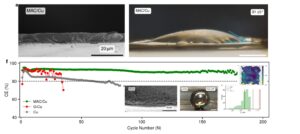
In our new paper in Advanced Science, we show that monolayer amorphous carbon (MAC)—a 2D material we pioneered—can change this behavior at the interface. A single-atom-thick, dopant-free layer turns copper uniformly lithiophilic, so lithium plates smoothly instead of forming whiskers or islands.
What excites us most is how simple and practical this is: an atomically thin coating, no doping, no thick interlayers, and direct compatibility with existing current collectors since MAC can be grown at ~ 200 °C. This makes it a promising route for anode-less lithium-metal batteries.
For more details, see here.