

3D interconnected pore networks enable superior volumetric CO2 uptake in amine-functionalized nanoporous carbon for direct air capture
Our group has just published a paper on carbon capture!
What is perhaps most interesting about this work is that it did not begin with carbon capture at all. It started with a materials problem in supercapacitors in collaboration with Murata and eventually led us to a scalable all-carbon architecture that may now be relevant for direct air capture.
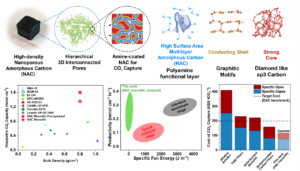
The material we developed is a high-density, all-carbon composite foam with a hierarchically interconnected porous network. Originally designed to support efficient charge transfer, it turns out that the same combination of conductivity, structural stability, and accessible surface area is also highly relevant for carbon capture systems.
Direct air capture faces a fundamental challenge: cost, driven in part by slow capture–release cycles and energy inefficiencies. Our approach explores Joule heating enabled by this material architecture, with the aim of accelerating these cycles and improving overall efficiency.
We are now developing this further through an LCER (Low Carbon Energy Research) Grant by A*STAR – Agency for Science, Technology and Research, including work toward a prototype system. It is still early, but preliminary data suggest that this route may reduce costs to below ~$200 per ton, with a possible path toward ~$100 per ton if the Joule heating concept can be validated at prototype scale.
For more information, see here.